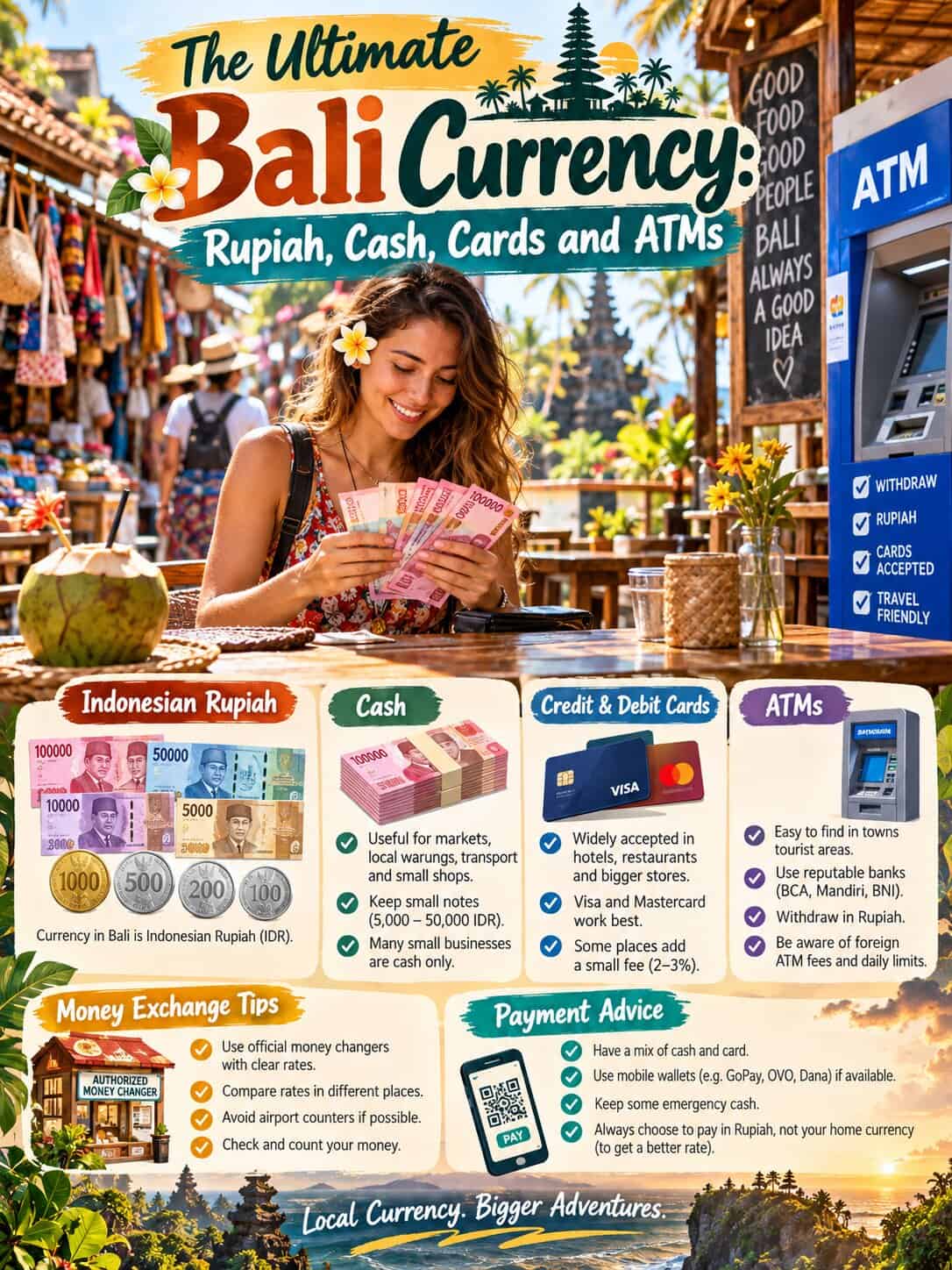
The Bali currency is the Indonesian rupiah (IDR). You pay in rupiah for food, transport, shopping, entrance fees and local services. Cards and digital payments are increasingly common in hotels, restaurants and established tourist businesses, but cash still matters at warungs, markets, small shops and anywhere outside the main tourist centers. This guide explains how rupiah works, when to use cash or a card, how ATMs and money changers compare, and how to avoid the usual traps. For the national picture, see our guide to paying with rupiah across Indonesia.
Bali Currency Checklist
| Question | Practical answer |
|---|---|
| What currency is used? | Indonesian rupiah (IDR, Rp); there is no separate Bali currency |
| Cash needed? | Yes: carry small notes for warungs, markets, parking and temples |
| Cards? | Widely accepted at hotels, larger restaurants and supermarkets; not everywhere |
| ATMs? | Widely available; fees depend on your bank and the ATM, so check first |
| Money changers? | Use established licensed ones and compare the rate |
| Currency conversion prompt? | Usually choose to pay in rupiah |
What Currency Is Used in Bali?
Bali uses the Indonesian rupiah, the same currency as the rest of Indonesia. Prices appear in several formats that all mean the same amount:
- Rp50,000
- 50,000 IDR
- 50k
All three mean fifty thousand rupiah. Bali currency prices look high because one rupiah has a small value, so a bill of several hundred thousand is normal. Check the number of zeros before you pay, especially when you are tired after a flight: Rp100,000 is one hundred thousand rupiah, not one hundred.
Can You Use US Dollars, Euros or Pounds?
Rupiah is the normal currency for everyday purchases. Some tourist-oriented businesses may quote or accept foreign currency, but do not rely on it, and if a price is given in dollars, confirm the final amount in rupiah before agreeing. Carrying some foreign cash is useful only if you plan to exchange it.
Bali Currency: Cash or Card?
The practical answer is to use both. You do not need to carry your whole budget in cash, but you do need some rupiah.
| Payment method | Best for |
|---|---|
| Cash | Warungs, markets, street vendors, parking, tips, temple fees and small purchases |
| Card | Hotels, resorts, shopping centers, larger restaurants, supermarkets and established businesses |
| ATM | Topping up rupiah when needed |
| Ride-hailing apps | Rides, where the payment method is set up in advance |
For a wider comparison across the country, read cash or card in Indonesia. Most established hotels and resorts take major cards, but small guesthouses may not, and some require a deposit or card authorization at check-in. Many tourist restaurants and major beach clubs take cards too, while small warungs may be cash-only, so ask before ordering. Contactless payments are spreading but are not universal, and local digital wallets can be harder for visitors to register, so an international card plus rupiah is still the simplest combination.
Bali Currency and ATMs: Tips and Fees
ATMs are widely available in cities and tourist areas, but do not assume every machine accepts every foreign card. If one fails, try another bank instead of repeating the same transaction. Prefer ATMs operated by established banks, ideally inside a bank branch or a shopping center, over unfamiliar standalone machines, and check the screen carefully before confirming a withdrawal.
ATM Fees to Watch For
- the Indonesian ATM operator’s own fee, if any;
- your bank’s foreign withdrawal fee;
- foreign exchange charges;
- currency conversion charges.
The exact fees depend on your bank, card and the ATM, and no ATM is guaranteed to be free, so check your bank’s international fee schedule before you leave. Also check whether your card has international withdrawal limits or needs a travel notification.
What Is Dynamic Currency Conversion?
At some ATMs and card terminals you may be offered a choice between being charged in rupiah or in your home currency. This is called dynamic currency conversion. In many situations it is better to choose rupiah, because your card issuer then handles the conversion instead of the machine or merchant applying its own rate. Always read the screen before confirming.
How Much Cash Should You Withdraw?
Do not withdraw more than you need just because you found a working machine. Take enough for your expected cash spending, keep the rest of your funds on cards or accounts, and remember that a smaller amount limits the damage if a wallet is lost or stolen.
Bali Currency Exchange: Money Changers
Many established money changers are used by travelers every day. The concern is not that all are unsafe but that some unfamiliar counters advertise unusually attractive rates and then add hidden fees or confusing calculations. Before you hand over money:
- check the rate on display and confirm the exact amount you should receive;
- count the money yourself before leaving the counter;
- keep the receipt when one is given;
- do not let anyone rush you, and walk away if the transaction feels confusing.
There is no single exchange rate that is always good. Compare the rate with the current mid-market rate and with other counters rather than memorizing a number.
Should You Exchange Money at the Airport?
Airport counters are convenient, but convenience does not guarantee the best rate. Exchange only enough for your first journey and compare rates later at reputable services. If you need to plan the trip from the airport, see how to get from the airport.
Bali Currency in Daily Life: Temples, Markets and Small Notes
In daily life, entrance fees, donations, parking and market purchases may not be payable by card. Small businesses often lack change for very large notes, so keep a mix of denominations. How much to carry each day depends on your itinerary: a resort stay paid mostly by card needs little, while markets, warungs and temples need more. Our guide on daily costs in Bali helps you estimate overall spending.
Tipping
Tipping is not identical to Western systems. Some restaurants and hotels add a service charge, and tips may be appreciated for certain services. Check the bill before adding an extra tip.
Bali Currency Mistakes to Avoid
- Check the price and count the zeros before paying.
- Count your cash before handing it over and check the change.
- Keep receipts for larger purchases.
- Decline unnecessary currency conversion.
- Keep a backup card separate from your main wallet.
- Do not carry your entire travel budget in one place.
Best Money Strategy for Bali
For handling Bali currency, a simple three-part approach works for most travelers: carry some rupiah for everyday spending, use a main card for hotels, restaurants and larger purchases, and keep a backup card in a separate place. Top up cash from a reputable ATM as needed rather than all at once.
Frequently Asked Questions
What currency does Bali use?
Bali uses the Indonesian rupiah, abbreviated IDR and written Rp. There is no separate local currency; the same rupiah is used across Indonesia.
Can I use US dollars in Bali?
Some tourist businesses may quote or accept foreign currency, but rupiah is the normal currency for everyday purchases. Always confirm the final amount in rupiah.
Should I carry cash in Bali?
Yes. Carry enough rupiah, ideally in small notes, for warungs, markets, parking, temple fees and businesses that do not take cards.
Can I use credit cards in Bali?
Yes, at most hotels, larger restaurants, supermarkets and many tourist businesses, but small local places may be cash-only.
Is it better to use an ATM or a money changer in Bali?
Both work. The better choice depends on your bank fees, the ATM operator and the local rate, so compare before you commit.
What is dynamic currency conversion at an ATM?
It is an offer to charge you in your home currency instead of rupiah. Choosing rupiah usually lets your card issuer do the conversion, which is often the better option.
Should I exchange money at Bali airport?
It is convenient, but convenience does not guarantee the best rate. Exchange only what you need for the first journey and compare rates later.
Should I bring more than one card to Bali?
Yes. A backup card, kept separately from your main wallet, protects you if one card is lost, blocked or declined.
Final Bali Currency Advice
Handling money in Bali is straightforward once you understand rupiah. Use both cash and cards, choose established ATMs and money changers, read conversion prompts carefully and keep a backup payment method. Once money is sorted, add a local SIM or eSIM for maps and ride apps. If you are still choosing where to base yourself, start with our guide to the best hotels in Bali or compare the best areas to stay in Bali.