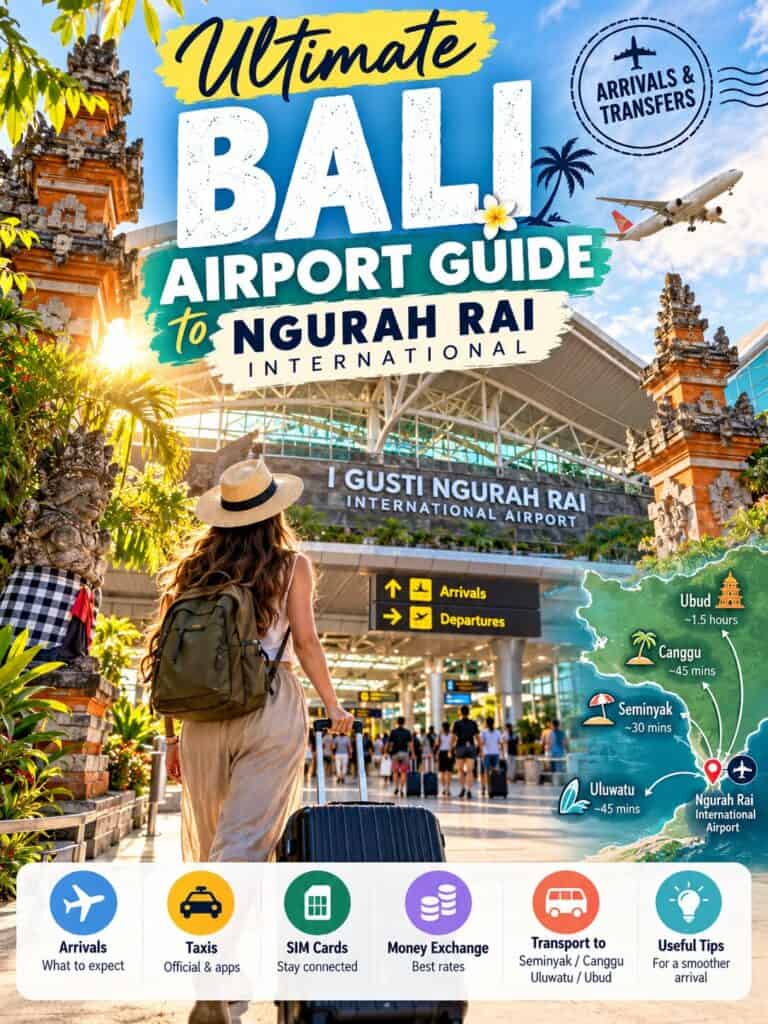
Quick answer: Bali Airport is Ngurah Rai International Airport (DPS), also called Denpasar International Airport, in Tuban in southern Bali. It has an international terminal and a domestic terminal, and it runs around the clock. From landing to the exit, international arrivals go through immigration, baggage claim and customs, then meet a driver or use a taxi, a ride-hailing app or a hotel shuttle. Plan the onward transfer before you land, because that is the part that causes most arrival stress.
The airport serves the island’s international and domestic travelers and sits close to Kuta, Seminyak, Sanur and Nusa Dua, while Ubud is farther inland and takes longer to reach. A planned battery-powered tram link to Canggu could add another transport option in the future. If you drive yourself, check the latest on the fuel shortage before you rent a car or scooter. Information below was last checked in October 2026, and airport procedures and prices can change, so confirm with your airline and transfer provider.
Where Is Bali Airport?
Ngurah Rai International Airport is in Tuban, in southern Bali. Despite the common name Denpasar Airport, it is not in central Denpasar. The location suits many popular tourist areas in the south, although traffic has a major effect on travel times.
Bali Airport Terminals: International and Domestic
Ngurah Rai has two passenger terminals: an International Terminal for flights to and from other countries and a Domestic Terminal for flights within Indonesia. They sit side by side in the same airport complex and are connected by a covered walkway, so you can walk between them if you are connecting. Sources describe the layout and terminal naming differently, so follow the signs and your airline’s instructions rather than relying on a fixed map.
| Terminal | Used for | What to know |
|---|---|---|
| International Terminal | Flights to and from other countries | Immigration, baggage claim and customs on arrival, check-in and security on departure |
| Domestic Terminal | Flights within Indonesia | Simpler arrival with no immigration, and the route to boats and onward domestic connections |
| Between terminals | Connecting passengers | Allow time to walk and to collect and re-check baggage if your tickets are separate |
International terminal traffic keeps growing as airlines add routes. TransNusa, for example, began daily direct flights between Bali and Melbourne from October 19, 2026, and several European airlines have added new Bali–Europe flight connections. Always check your terminal on your booking before you travel, because terminal procedures can change.
Arriving at Bali Airport: Step by Step
International arrivals follow this sequence, from the aircraft door to the street:
- Before you land: complete the free digital arrival form (the All Indonesia customs and health declaration) and, if you are eligible, buy your e-VOA online. You will also need to pay the Bali tourist levy of IDR 150,000 per person online. Keep the QR codes on your phone.
- Immigration: join the visa-on-arrival or e-VOA line, depending on your documents. The visa on arrival costs IDR 500,000 for eligible nationalities. Have your passport, return ticket and QR codes ready.
- Baggage claim: the screens show which carousel belongs to your flight number.
- Customs: your customs QR code is scanned, and bags may be checked.
- Exit to the arrivals hall: drivers, taxi counters and money exchange counters are here.
- Transport: meet your driver, use an official taxi counter or follow the ride-hailing instructions below.
The levy and entry rules are set by Bali’s authorities and Indonesian immigration, and they change from time to time. Sources differ on whether the levy is charged once per trip or per entry, so check the official portal before you travel. During busy periods, immigration and baggage collection can take longer than expected. If you have a connecting flight, allow enough time between flights and remember that you may need to collect and re-check baggage depending on your itinerary.
Meeting Drivers and Where to Find Transport
After customs, you walk into the public arrivals hall, where drivers wait behind a barrier holding name signs. If you have pre-booked a transfer, agree on the meeting point with your driver in advance, and save their phone number, since the hall is busy and several drivers may hold signs. Official taxi counters sit inside the hall, and ride-hailing pickup points are usually outside, in areas that can differ from normal street pickups.
Avoid unsolicited offers from people who approach you inside or just outside the terminal. If you do not have a driver, walk to the official counter or follow the app’s pickup instructions instead.
Bali Airport Transport Options Compared
| Option | Cost level | Best for | Things to know |
|---|---|---|---|
| Pre-booked airport transfer | Fixed price agreed in advance, in the middle | Late arrivals, first-time visitors, families | The driver meets you with a name sign; confirm that the provider tracks your flight number |
| Official airport taxi counter | Often the highest of the taxi options | Arrivals without a booking | Zone-based fixed fares paid at the counter; confirm the price before you go |
| Ride-hailing (Grab, Gojek) | Usually cheaper than the counter | Travelers with mobile data | Airport pickup areas and rules differ from normal street pickups, so follow the app and signs |
| Private driver | Higher, but flexible | Groups and travelers continuing to sightseeing | Can double as a day-trip driver |
| Hotel shuttle | Varies; sometimes free | Resorts and hotels near the airport | Ask your hotel at booking |
Our guides to Grab in Bali, Gojek in Bali and taxis and private drivers in Bali cover prices and booking in more detail. For your first days, a local SIM or eSIM makes ride-hailing and navigation much easier, so see our Bali SIM and eSIM guide.
How Long Does It Take From Bali Airport?
Travel time depends heavily on traffic, so use these as rough guides for normal conditions and allow extra time during rush hours and holidays:
| Destination | Rough travel time | Notes |
|---|---|---|
| Kuta and Legian | 10 to 20 minutes | Closest major tourist area |
| Nusa Dua and Jimbaran | 20 to 35 minutes | Resort areas to the south and southeast |
| Sanur | 20 to 40 minutes | Departure point for fast boats to the Nusa islands |
| Seminyak | 20 to 40 minutes | Longer in rush hour |
| Canggu | 30 to 60 minutes or more | Heavy traffic can make it much longer |
| Ubud | 60 to 90 minutes or more | Inland, with slower roads |
Do not rely only on the distance shown on a map, because traffic can change the journey time significantly.
Bali Airport to Kuta, Seminyak, Canggu, Sanur and Ubud
Kuta: one of the closest tourist areas, which makes it practical for a first or last night, particularly before an early flight. Seminyak: north of the airport, popular for hotels, restaurants and beach clubs, with travel time that varies a lot by traffic. Canggu: farther north, and a pre-arranged transfer is more convenient after a long flight, so read our Canggu transport guide.
Sanur: east of the airport and a popular area for first-time visitors, with fast boats to the islands. See Bali Airport to Sanur for the best ways to get there. Nusa Dua: southeast of the airport and home to many large resorts, with a generally straightforward transfer. Ubud: inland in central Bali and considerably farther, so booking a private transfer makes the journey more comfortable. Our guide to getting from Bali Airport to Ubud compares the options.
Getting to Nusa Penida and Nusa Lembongan
You cannot travel directly from the airport to Nusa Penida or Nusa Lembongan. You first need to reach a harbor used by fast boats, and Sanur is one of the most common departure points. Allow a generous buffer between your flight arrival and the boat departure, because airport delays and road traffic can affect your schedule. See Sanur to the Nusa Islands for boat options.
How Early Should You Arrive for a Flight?
For international departures, arriving around three hours before your scheduled departure is a reasonable general guideline. Domestic flights may need less time, but follow your airline’s instructions. Allow extra time during holidays and weekends, and arrive earlier if you need to return a rental vehicle or check bulky luggage.
Facilities, Wi-Fi and Money
Ngurah Rai has restaurants, cafes, shops, currency exchange counters and other passenger services, although the exact services can change over time. Wi-Fi and mobile connectivity are available, but do not rely only on airport internet, and consider arranging a local SIM or eSIM before your trip.
Currency exchange counters are available, but airport rates are not always the most competitive, so exchange only a small amount for immediate needs and compare rates for larger sums. See our Bali currency and money guide for rupiah, cards and ATMs, and how much Bali costs for budgeting.
Arriving or Departing at Night
Ngurah Rai operates around the clock because flights arrive throughout the day and night. Transport options and nearby businesses are more limited late at night, so if your flight lands very late, arranging a transfer in advance reduces stress. For a short stay or a very late arrival, staying near the airport can be practical, and our guide to hotels near Bali Airport compares the options.
What to Do If Your Flight Is Delayed
If your flight is delayed, contact your accommodation or transfer provider as soon as possible. For a pre-booked transfer, check whether the company monitors flight numbers and adjusts pickup times automatically. If you have a separate domestic flight or boat connection, check the conditions of your booking before assuming that you will still make it.
Bali Airport Travel Tips
- Keep your accommodation address available offline.
- Save your driver’s or transfer company’s contact information.
- Complete the digital arrival form and pay the tourist levy before you land.
- Do not accept unsolicited transport offers.
- Allow extra time because Bali traffic can be unpredictable.
- Have some Indonesian rupiah available for small expenses.
- Keep important documents and valuables in your carry-on luggage.
- If you are continuing to another island, leave a comfortable buffer between your flight and boat departure.
- For late-night arrivals, arrange transportation before leaving the home airport.
First-Time Visitors: What to Plan
Ngurah Rai is relatively easy to navigate, and the most important thing to plan is your onward transportation. Choose your airport transfer by destination, arrival time, luggage and budget. For longer trips, the airport is simply the start of exploring Bali’s regions, so see our Bali travel guide, where to stay in Bali and general Indonesia travel tips.
Bali Airport FAQ
What is Bali Airport officially called?
Ngurah Rai International Airport (DPS), also known as Denpasar International Airport. It is in Tuban in southern Bali, not in central Denpasar.
How many terminals does the airport have?
Two: an international terminal and a domestic terminal, side by side and connected by a covered walkway.
What is the sequence for international arrivals?
Immigration (visa on arrival or e-VOA), baggage claim, customs with a QR code scan, then the arrivals hall and your transport.
Where do I meet my driver on arrival?
In the public arrivals hall after customs, where drivers hold name signs. Agree on the meeting point with your driver in advance and keep their number.
What are the main ways to get to your hotel?
A pre-booked transfer, the official taxi counter, ride-hailing, a private driver or a hotel shuttle. Compare them in the table above.
How long does it take to get to Ubud?
Roughly 60 to 90 minutes or more, depending on traffic, since Ubud is inland.
Is the airport open 24 hours?
Yes. Ngurah Rai operates around the clock, though transport and nearby businesses are more limited late at night.
Do I need to pay anything on arrival in Bali?
Eligible nationalities pay the visa on arrival (IDR 500,000) unless they buy an e-VOA online, and the Bali tourist levy is IDR 150,000 per person. Rules change, so check the official sources before you travel.