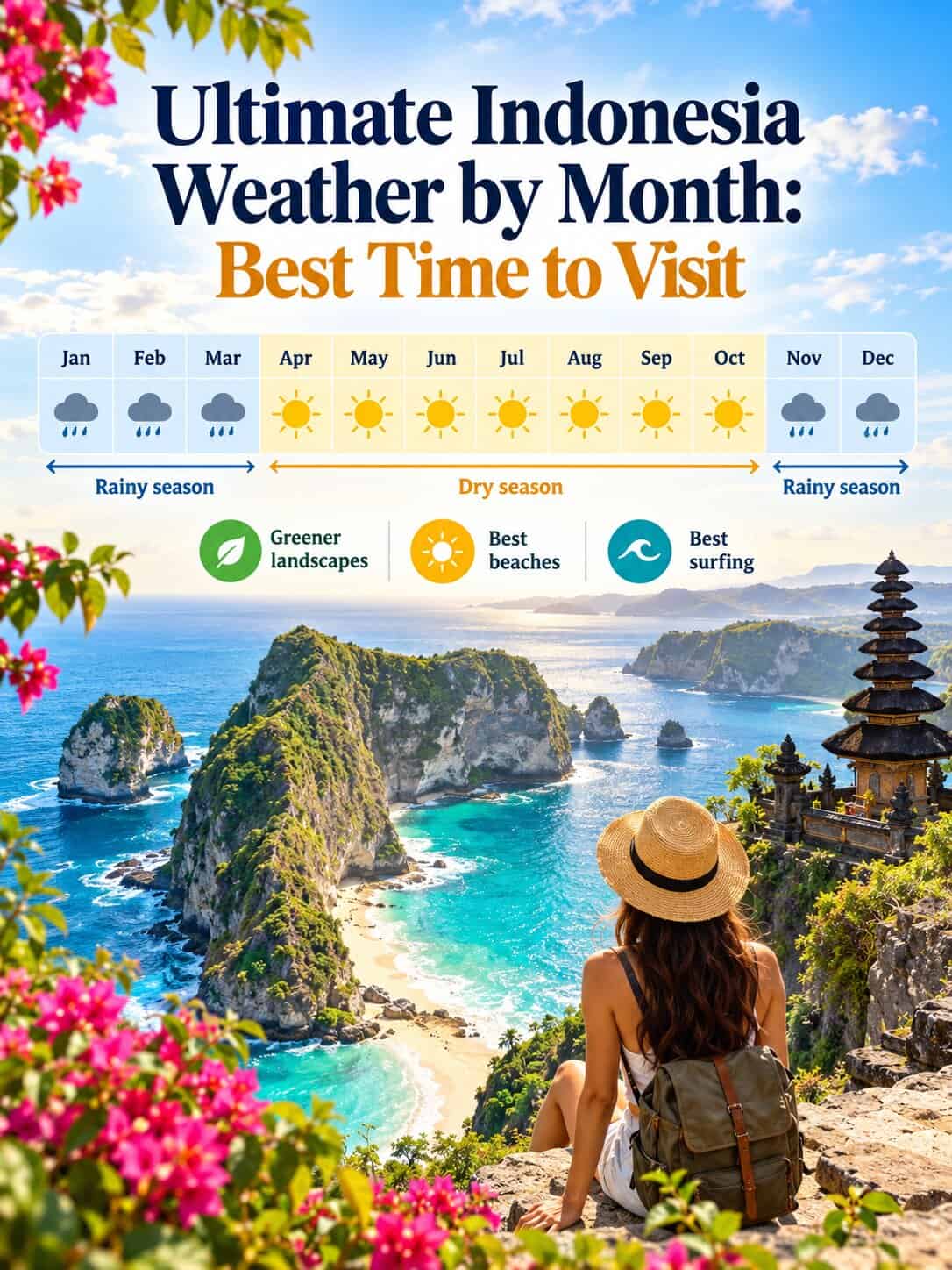
The best time to visit Indonesia depends on which island you plan to explore. Bali, Java, Lombok and Komodo generally experience drier conditions from roughly April to October, while Raja Ampat often offers better marine travel conditions from October to April. Much of Sumatra and Borneo stays humid and rainy throughout the year. For a first trip focused on Bali and Java, May, June or September can balance reasonably dry conditions with fewer peak-season crowds; for Raja Ampat diving or island-hopping, consider October–April. This Indonesia weather by month guide explains the differences, not a single national forecast.
Indonesia has a tropical climate with relatively limited changes in coastal temperature and much bigger changes in rainfall, winds and sea conditions. Much of Bali and Java has an approximate dry season from April to October and wetter conditions from November to March, but those ranges do not apply uniformly to every island or elevation. Compare the month with your destination and activity—beach holiday, volcano trekking, diving or long-distance boat travel—rather than assuming the national season applies everywhere.
Use the seasonal table below to choose the right destination for each month, with separate notes for Bali, Java, Lombok, Flores, Komodo, Sumatra, Sulawesi and Raja Ampat. The patterns describe typical climate and are not guarantees for a specific holiday.
As a rule of thumb, May–September is convenient for Bali, Java and Lombok sightseeing, while October–April is often more suitable for Raja Ampat marine trips. Hiking and island boats also depend on formal park closures, current weather and sea forecasts.
Regional rainfall patterns, altitude and sea exposure matter more than the label “rainy season” or “dry season.” Confirm the exact destination first and use current BMKG forecasts for the days before departure. Once your dates are set, compare flights to Indonesia.
Indonesia Weather by Month at a Glance
| Month | General Weather Pattern | Travel Conditions |
|---|---|---|
| January | Wet season in many regions | Hot, humid and wetter; flexible itineraries are useful |
| February | Wet season | Frequent rain in many destinations |
| March | Wet season gradually begins to ease | Mixed conditions depending on destination |
| April | Transition toward drier weather | Good shoulder-season option |
| May | Generally becoming drier | Good balance of weather and fewer crowds |
| June | Drier conditions in many popular destinations | Excellent for outdoor activities |
| July | Dry season in many regions | Popular and often busy |
| August | Dry season in many regions | Good weather but high travel demand |
| September | Generally dry in many destinations | Good weather with fewer peak-season crowds |
| October | Transition toward wetter conditions | Mixed conditions; good in some regions |
| November | Rain becomes more common | Wet-season conditions increasing |
| December | Wet season in many regions | Hot, humid and wetter in many destinations |
These are broad national patterns. Indonesia covers a huge geographic area, so local conditions can differ significantly between islands and regions.
Best Time to Visit Indonesia by Island
| Island / region | Recommended months | Main activities | Important exception |
|---|---|---|---|
| Bali | May–September | Beaches, temples, outdoor sightseeing | April/October can also work; surfing conditions depend on coast |
| Java (Yogyakarta, Bromo) | May–September | Temples, volcano viewpoints, city trips | Highlands much colder than coast; volcanic access can close |
| Lombok / Gili Islands | May–September | Beaches, hikes, snorkelling | Rinjani trail access is seasonal and requires registration |
| Flores / Komodo | April–June, September–November | Boat tours, Komodo trekking and viewpoints | Strong winds or currents may affect boats even in dry months |
| Raja Ampat | October–April | Diving, snorkelling and island hopping | Marine conditions vary by location and day |
| Sumatra | Destination-specific | Rainforest, lakes, orangutan areas | Frequent rain can occur all year; north and west differ |
| Kalimantan (Indonesian Borneo) | Destination-specific | Rainforest and river travel | High rainfall possible year-round; river conditions matter |
| Sulawesi | Destination-specific | Toraja, marine tourism and wildlife | Different coasts may have different rainfall peaks |
| Maluku / Ambon | Destination-specific | Island travel and marine tourism | Some local rainy-season cycles differ from Bali’s |
These are climatological planning windows, not guaranteed daily weather. A destination such as Raja Ampat may have calmer marine travel in months when Bali and Java are wetter, so select the island before selecting the month.
Which Months Are Best for a Multi-Island Indonesia Trip?
May–June or September works well for itineraries combining Bali + Yogyakarta + Lombok or Komodo. For Raja Ampat + West Papua marine activities, consider October–April instead. If attempting Bali and Raja Ampat together, October is a potential transition compromise, but boat and rain conditions still vary and there is no guaranteed perfect month for both regions.
January Weather in Indonesia
January is generally part of the wetter period in many Indonesian destinations. Temperatures remain warm, while humidity and rainfall can be high.
Rain does not necessarily mean continuous bad weather. Tropical rainfall can arrive as intense showers followed by periods of clearer weather. However, travelers should allow more flexibility for outdoor activities and transportation.
January can work well for travelers who are more interested in cities, culture, food and flexible sightseeing than in having perfect beach weather every day.
Island-hopping and boat journeys require particular attention to local sea conditions during wetter periods.
February Weather in Indonesia
February is also generally within the rainy season in many parts of Indonesia.
Expect warm temperatures, high humidity and a greater chance of heavy rainfall. Conditions can vary considerably from one day to another, so flexible plans are useful.
Travelers who visit during February should avoid building an itinerary around tightly scheduled outdoor activities every day.
Despite the rain, February can still be an enjoyable month for a trip if you are prepared for changing conditions and choose destinations that offer plenty to do beyond the beach.
March Weather in Indonesia
March is often a transition period. Some destinations may still experience significant rainfall, while conditions gradually begin to improve in others.
Temperatures remain warm and humidity can still be high.
March can be an interesting option for travelers who want to avoid the busiest part of the year and are comfortable accepting some weather uncertainty.
Because regional differences become particularly important during transition periods, check the forecast for your specific destination before finalizing an itinerary.
April Weather in Indonesia
April is generally one of the more useful shoulder-season months for travel. In many destinations, rainfall begins to decrease as conditions move toward the drier part of the year.
The weather can still be variable, particularly early in the month, but outdoor travel often becomes more convenient.
April is a good option if you want to combine sightseeing, beaches and outdoor activities without traveling during the busiest summer period.
May Weather in Indonesia
May is often one of the best months to visit Bali, Java, Lombok and the Labuan Bajo/Komodo area: much of southern Indonesia is moving into the dry season, while July–August peak-season demand has not yet reached its height. For Raja Ampat, however, sea conditions can be less favourable than in its usual October–April window. Travel comfort also depends on regional school holidays and exact weather patterns.
In many popular destinations, conditions are becoming drier while travel demand is still below the peak July and August period.
Beaches, hiking and sightseeing can all work well during May, although the exact conditions depend on the island you choose.
June Weather in Indonesia
June is generally within the drier travel season in Bali, Java and Lombok, rather than the universal start of the Indonesian dry season. It can be useful for beach time and temple visits, while Komodo boat itineraries still require checks for wind, waves and currents. Raja Ampat follows a different marine-season pattern.
Rainfall generally becomes less frequent in many tourist destinations, making June a strong month for outdoor activities, beaches, hiking and island-hopping.
Travel demand also begins to increase, but June is often less busy than the peak summer months.
July Weather in Indonesia
July is a high-demand dry-season month for Bali, Lombok and much of Java. Beaches and volcano viewpoints can be attractive, but popular hotels and flights may fill and some exposed sea routes can be windy. Raja Ampat is not automatically in its best boating period in July simply because Bali is drier.
Many major tourist destinations experience relatively dry conditions, making the month attractive for beach holidays, sightseeing and outdoor activities.
The main disadvantage is demand. Hotels, flights and popular attractions can be considerably busier, especially in destinations such as Bali.
If you are traveling in July, book important accommodation and transportation in advance.
August Weather in Indonesia
August is one of the driest and busiest periods in southern Indonesia, especially Bali, Java and Lombok, but “dry” does not mean calm seas or zero rain. Some boat routes face seasonal wind and swell; reserve essential transport with flexibility, and do not apply this month’s conditions to Raja Ampat without local marine forecasts.
In many popular destinations, the weather is favorable for outdoor activities, with relatively low rainfall compared with the wetter part of the year.
However, August can also bring high demand and busy tourist areas. Travelers looking for quieter experiences may prefer May, June, September or October depending on the destination.
September Weather in Indonesia
September is frequently a strong month for Bali, Java, Lombok and Komodo, with much of southern Indonesia still in its drier season and some easing in peak visitor demand. It is a practical choice for cultural sightseeing and trekking where official trails are open. In Raja Ampat, a marine trip may benefit from waiting until the more usual October–April calm-water window.
Many destinations can still experience relatively dry conditions, while tourist numbers may begin to decline after July and August.
This makes September particularly attractive for travelers who want to combine beaches, sightseeing and outdoor activities.
October Weather in Indonesia
October is a transition month for Bali and Java, but also marks the beginning of a more favourable marine period for Raja Ampat. Komodo can still offer attractive conditions, particularly earlier in October and with a suitable boat forecast. This is a clear example of why the best month for Indonesia depends on island and activity.
The exact timing of the seasonal change varies, so October should not be treated as uniformly wet or dry across Indonesia.
If you are traveling during October, build some flexibility into your itinerary, particularly if you are planning boat trips or outdoor activities.
November Weather in Indonesia
November typically brings the wet-season transition to Bali, Java and some neighbouring areas, but rainfall onset varies by year and region. Raja Ampat can offer a better sea-travel window in this period. For the 2026/27 season, BMKG forecasts a later-than-normal start of rain across many seasonally defined zones, so a long-term average does not guarantee November rain everywhere.
Rain becomes more frequent, while temperatures remain warm and humidity can be high.
This can still be a perfectly reasonable time to travel if you are flexible. The main consideration is that outdoor plans may need to change because of rainfall.
December Weather in Indonesia
December is generally wetter across much of Bali and Java, although holiday travel demand can remain high. Raja Ampat is often within its preferred October–April marine season. Mountain routes and fast-boat crossings need local warnings and buffer days; do not assume the entire country follows the same December rainfall pattern.
Expect warm temperatures, high humidity and a greater chance of heavy tropical rain. Weather conditions can change quickly, so travelers should avoid scheduling every day around weather-dependent activities.
December can nevertheless be a busy travel period because of the Christmas and New Year holidays. Popular hotels and transportation can become more expensive and harder to book.
Average Temperature in Indonesia by Month
Coastal Indonesia is warm all year, but elevation changes the experience dramatically. Indonesia’s tourism authority describes broad average conditions near 28°C in coastal plains, 26°C in inland and mountain areas and 23°C in higher mountain regions, with typical humidity around 70–90%. These are broad environmental averages, not monthly forecasts and not exact temperatures for Bali, Jakarta or a volcano summit. The section below compares different locations more usefully than a national table of months labelled only “warm.”
There is no single temperature range that accurately describes every Indonesian island. Elevation also matters: mountain destinations can be considerably cooler than coastal areas.
Indonesia Temperature: Coastal Cities vs Mountains
| Environment | Broad temperature reference | What travellers should pack |
|---|---|---|
| Coastal lowlands | About 28°C broad annual average | Lightweight clothes, sun protection and rain layer |
| Inland / mountain areas | About 26°C broad category average | Walking shoes, rain protection and light layer |
| Higher-altitude regions | About 23°C broad category average | Warmer layers, especially at night |
| High volcano summits | Can be far colder than the general highland average | Warm jacket and appropriate trekking gear |
These broad national altitude-zone averages are not monthly temperature data. Humidity is typically high, often around 70–90%. Avoid using the table to promise exact daytime temperatures at Jakarta, Denpasar, Labuan Bajo or a mountain campsite. City-level climate normals are required before publishing a genuine 12-month numerical temperature or rainfall table.
Why Temperature by Month Matters Less Than Rainfall
Daylight length and coastal heat change less through the year than rainfall, sea swell and local mountain cloud. A city may have a similar average temperature in January and August but very different conditions for a ferry, beach swim, volcano sunrise or rainforest walk.
Indonesia Dry Season by Month
The Indonesia dry season is commonly described as April–October for major Java and Bali destinations, with May–September often providing particularly practical outdoor conditions. Lombok and parts of Flores share a broadly similar southern monsoon cycle. Sumatra, Kalimantan, Sulawesi, Maluku and Raja Ampat can differ strongly; a calendar for Bali is not a national timetable.
June, July, August and September are often the most reliable months for travelers who prioritize dry weather.
May and October can also be good choices because they sit closer to the seasonal transition and may offer a useful compromise between weather and crowds.
Indonesia Dry Season: Typical Pattern vs 2026/27 Forecast
Typical pattern: for Bali and Java, the drier season often runs April–October and the wetter season roughly November–March. This is climate guidance, not a promise about a particular year.
BMKG seasonal outlook dated September–October 2026: the agency expects a later-than-usual start of the 2026/27 rainy season across 529 seasonal zones, representing 61.08% of Indonesia’s land area, associated with a very strong El Niño. Across Indonesia, many areas are forecast to begin their rainy season in November (185 zones) or December 2026 (266 zones), with numerous areas peaking from December 2026 through February 2027. This does not mean no rain will fall before the formal season begins; the forecast may be revised.
| Question | Typical climate | 2026/27 specific outlook |
|---|---|---|
| When does the rainy season begin? | Often November in Bali and Java, with strong local variation | Delayed onset forecast in 61.08% of Indonesia’s land area |
| Are all islands the same? | No; Raja Ampat and some Maluku/Sulawesi regions differ | Predictions vary across climate zones |
| When is rainfall heaviest? | Often Dec–Feb for much of Java/Bali | Many regions forecast to peak Dec 2026–Feb 2027 |
| Does delayed rainfall mean a completely dry season? | No | No; BMKG still predicts normal seasonal rainfall totals across much of the country |
Indonesia Rainy Season by Month
For many southern destinations, especially Bali and Java, wetter months often stretch from roughly November through March. Rain can arrive in brief showers or prolonged storms; flooding, landslides and ferry disruption are possible during heavy weather. The start of the season varies substantially by year. The 2026/27 BMKG outlook, for example, forecasts later onset across more than half the country’s area.
December, January and February are commonly associated with wetter conditions, but rainfall varies significantly by region.
The rainy season should not be interpreted as six months of constant rain. Tropical rainfall patterns can be highly variable, with heavy showers separated by periods of sunshine.
If your trip depends heavily on beaches, hiking or boat transportation, allow additional flexibility during these months.
Best Weather Months for a Beach Holiday
For Bali, Lombok and southern Java beaches, May–September often offers more reliable dry weather, though currents and seasonal surf can still make swimming dangerous. For Raja Ampat marine excursions, the usual favourable window is October–April. Distinguish a dry beach day from safe swimming, diving or boat conditions: waves and currents need separate checks.
June through September are particularly attractive in many areas, although July and August can be crowded.
May and September can provide a better balance if you want favorable conditions without traveling at the absolute peak of the tourist season.
Best Weather Months for Hiking
Mountain trekking is often easier during a region’s drier months, but official access rules control whether a hike is possible. For example, Mount Rinjani trekking closed January 1–March 31, 2026 and reopened April 1 with a maximum of 700 climbers per day across six official routes, using the e-Rinjani registration system. Conditions on volcanoes and steep trails can change due to eruptions, storms and park instructions even in July or August.
This is particularly relevant for volcano hikes and longer mountain routes where heavy rain can make trails more difficult or uncomfortable.
However, mountain weather can change rapidly even during the dry season. Always check current conditions before starting a hike.
Best Weather Months for Island Hopping
Island-hopping is highly dependent on sea conditions, especially when your itinerary involves fast boats and smaller vessels.
Drier periods can provide more predictable conditions in many destinations, although weather and sea conditions can still change.
If you are building a multi-island itinerary, avoid scheduling important connections too tightly. A spare day can protect the rest of your trip if a boat or flight is delayed.
Indonesia Island-Hopping Weather: Boats, Waves and Buffers
| Route area | Typical planning window | What can still go wrong |
|---|---|---|
| Bali–Nusa Penida / Lembongan | Often May–September for less rain | Strait swell and strong currents even on sunny days |
| Labuan Bajo–Komodo | April–June and September–November often attractive | Afternoon wind, waves, route cancellation and park quota |
| Raja Ampat islands | October–April often more suitable | Inter-island exposure, tidal currents and local storms |
| Lombok–Gili | Often May–September for weather | Channel conditions and fast-boat service changes |
Leave a buffer of at least one day between a weather-sensitive boat excursion and an expensive onward flight. Use a reputable operator, wear a life jacket and choose a departure based on the local marine forecast rather than the national rainfall map.
Best Time to Visit Indonesia by Region
National averages are useful for understanding broad seasonal patterns, but they should not replace destination-specific information.
Bali and Lombok
Bali and Lombok are among the most popular island destinations and are generally associated with a drier period and a wetter period. The drier months are particularly popular for beach holidays and outdoor activities.
For detailed Bali planning, see our Best Time to Visit Bali guide.
Java
Java has significant regional and elevation differences. Coastal areas, major cities and mountain destinations can experience different conditions.
If Java is part of your itinerary, use destination-specific weather information rather than relying only on the national monthly pattern.
Sumatra
Sumatra covers a huge area, so rainfall patterns can differ considerably across the island. Travelers planning jungle, wildlife or mountain activities should check local conditions carefully.
Flores and Komodo
Eastern Indonesian destinations can have different seasonal patterns from areas farther west. This is particularly important for travelers planning boat trips around Komodo and Flores.
Raja Ampat
Raja Ampat has its own local weather patterns, and marine conditions are especially important when planning diving, snorkeling and boat travel.
Raja Ampat vs Bali: Different Best Travel Seasons
Raja Ampat is commonly recommended for marine tourism from October to April, when several of its boat and dive regions tend to have more suitable sea conditions. Bali and Java are typically drier during roughly April–October, especially May–September. Raja Ampat’s best season is therefore not simply an extension of Bali’s. Diving visibility, currents, wind and availability of long-distance boats differ between Waigeo, Piaynemo and Misool.
Komodo and Flores: Weather Is Not the Only Restriction
Komodo National Park works especially well for many trips in April–June and September–November; July and August can be busy, and sea conditions still matter. From April 1, 2026, the park introduced a maximum of 1,000 visitors per day with advance visitor registration through the SIORA system. A good weather month does not replace the entry and ranger requirements.
Best Time to Visit Indonesia: Activity Planner
| Experience | Best general period | Key planning constraint |
|---|---|---|
| Bali temples and rice terraces | May–September | Expect some rain even in the dry season |
| Yogyakarta and Borobudur/Prambanan | May–September | Midday heat can still be intense |
| Mount Bromo viewpoint | May–September | Predawn temperatures can be cold; volcanic restrictions apply |
| Mount Rinjani trekking | During officially open climbing season | 2026 reopening April 1; 700 climbers/day cap and e-Rinjani permit |
| Komodo dragon viewing and boat trips | April–June / September–November | 2026 quota 1,000 visitors/day; SIORA reservation and sea conditions |
| Raja Ampat diving and boat tours | October–April | Current waves, currents and visibility vary |
| Sumatra rainforest wildlife | Year-round with local adjustments | Allow for wet trails, rain and travel delays |
| Bali / Lombok surfing | Depends on coast and break | West and east coast swell exposure differs; surf forecast required |
In marine destinations, the dry season is not the same as calm water: wind, currents and swell can disrupt tours. In mountain parks, a sunny day cannot override an official permit requirement, closure or active volcanic alert.
Does Indonesia Have the Same Weather Everywhere?
No. Indonesia is an enormous archipelago, and weather varies between islands and regions.
Even within one island, elevation and geography can affect rainfall and temperature. Mountain destinations can be cooler, while coastal areas remain hot and humid.
This is why a national weather-by-month guide should be used as a starting point rather than an exact forecast for a specific destination.
What Is the Best Month to Visit Indonesia?
There is no single best month for the entire country.
For many popular destinations, May, June, September and October can offer an attractive combination of weather and manageable crowds. June through August are often excellent for outdoor activities but are also among the busiest months.
If weather is your highest priority, choose the destination first and then select the months with the most favorable local conditions.
What Is the Worst Month to Visit Indonesia?
There is no universally worst month either.
January and February can be challenging for travelers who want a completely beach-focused holiday because many destinations experience wetter conditions. However, they can still work for flexible travelers.
A month becomes a poor choice mainly when its weather pattern conflicts with the purpose of your trip. A traveler planning a beach and boat holiday has different requirements from someone visiting cities, museums and cultural attractions.
Is Indonesia Worth Visiting During the Rainy Season?
Yes. Rainy-season travel can still be enjoyable.
Rain can be heavy but relatively short, and you may still have plenty of sunshine between showers. The main difference is that weather-dependent activities require more flexibility.
Traveling outside the peak dry season can also mean fewer crowds and potentially better accommodation availability.
For a deeper look at rainfall patterns, humidity and what to pack, see our dedicated guide to Indonesia’s rainy season.
What Should You Pack for Indonesia Weather?
Lightweight clothing is useful throughout the year in Indonesia. You should also prepare for rain regardless of the season, particularly if you are traveling between several regions.
- Lightweight breathable clothing
- Comfortable walking shoes
- A compact rain jacket or umbrella
- Swimwear for beach and island destinations
- Sun protection
- A small day bag for changing weather conditions
If you are visiting mountain areas, pack additional layers because temperatures can be significantly cooler at higher elevations.
Final Advice: Best Time to Visit Indonesia
The most important thing to remember is that Indonesia does not have one universal travel season. Weather changes from region to region, and the best month depends on where you are going and what you want to do.
For a first itinerary centred on Bali, Java, Lombok or Flores, May–September is often a practical time to go. For Raja Ampat, prioritise the different October–April marine season. The ideal travel window depends on the island, the exact location, your activities and actual forecasts rather than one universal Indonesian calendar.
If you are traveling during the wetter months, do not automatically cancel your plans. Instead, build flexibility into your itinerary and choose activities that are not completely dependent on perfect weather.
Once you know your preferred travel dates, use our Indonesia Travel Guide to plan the rest of your trip and choose the destinations that fit the season.
Related guides: Bandung Weather by Month: Rain, Temperature & Best Time to Visit
Indonesia Weather FAQ
What is the rainy season in Indonesia?
In many parts of Indonesia, the rainy season generally falls between November and March. The exact timing varies by island and region.
What is the dry season in Indonesia?
Many popular destinations experience their drier period roughly from April or May through October. June to September are often among the driest months in major tourist areas.
Is Indonesia hot all year?
Most lowland and coastal areas remain warm throughout the year. Temperature changes are generally less significant than changes in rainfall and humidity.
Does it rain all day during the rainy season?
No. Tropical rain can arrive in short, heavy showers followed by clearer periods. However, longer periods of rain can also occur, so conditions remain less predictable.
What are the best months for Bali weather?
Bali is generally most popular during its drier period. For detailed information about Bali’s seasonal conditions, see our dedicated Best Time to Visit Bali guide.
Is July a good month to visit Indonesia?
Yes. July is a popular month because many destinations have relatively dry conditions. The trade-off is higher demand and more crowded tourist areas.
Is August a good month to visit Indonesia?
Yes. August can provide excellent conditions in many popular destinations, but it is also one of the busiest travel periods.
Is January a bad time to visit Indonesia?
Not necessarily. January is wetter in many regions, but travelers with flexible plans can still enjoy Indonesia. It is less suitable for itineraries that depend entirely on clear weather.
What is the best time to visit Indonesia for the first time?
For a first itinerary covering Bali and Java, May, June or September often provides a good balance of relatively dry weather and manageable crowds. For Raja Ampat, October–April is usually better for marine travel.
What is the best time to visit Bali and Lombok?
May–September generally offers drier weather on both islands, although rain and rough seas are still possible. July and August are popular and can be busier.
Is Indonesia’s dry season the same everywhere?
No. Much of Bali and Java is generally drier April–October, while Raja Ampat is often preferred for marine tours October–April. Sumatra, Kalimantan, Sulawesi and Maluku need region-specific guidance.
Which month is best for Komodo National Park?
April–June and September–November often balance suitable outdoor conditions and visitor numbers. Check marine forecasts and park access: the 2026 system has a daily visitor limit of 1,000 and advance SIORA registration.
When should I visit Raja Ampat for diving?
October–April is commonly favoured for calmer marine conditions in many areas, but daily wind, swell, underwater visibility and currents can differ by island.
Can I trek Mount Rinjani in January or February?
Not during the 2026 seasonal closure: official Rinjani hiking routes were closed January 1–March 31 and reopened April 1. The park operates permits and daily capacity restrictions, so use the current open-season rules rather than weather alone.
How hot is Indonesia in July compared with January?
Temperature changes less than rainfall in most coastal lowlands. Indonesia’s tourism authority describes broad coastal averages around 28°C; actual monthly highs, lows and rainfall depend on the city and elevation.
Will El Niño make Indonesia dry in late 2026?
BMKG’s September–October 2026 seasonal forecast expects delayed rainy-season onset across much of the country, but not the disappearance of rainfall. Many regions are forecast to experience a rainy-season peak between December 2026 and February 2027.
Is October a good month to visit Indonesia?
October can work well for a transition-season Bali or Java visit, while Raja Ampat enters its typical favourable marine window. Local rainfall and boat conditions still vary.
What is the best time for Indonesia island hopping?
Choose the route first. Bali and Lombok trips often suit the drier months, while Raja Ampat usually has a different October–April window. In all cases check wind, wave height, currents and ferry schedules and leave buffer time.
Does the rainy season mean rain all day?
No. Tropical storms may be brief, but heavy rain can also last longer and affect transport, landslides and access to outdoor sights. Weather can differ greatly between islands and elevations.